Your AI won't differentiate you from your competitors. They run the exact same one.
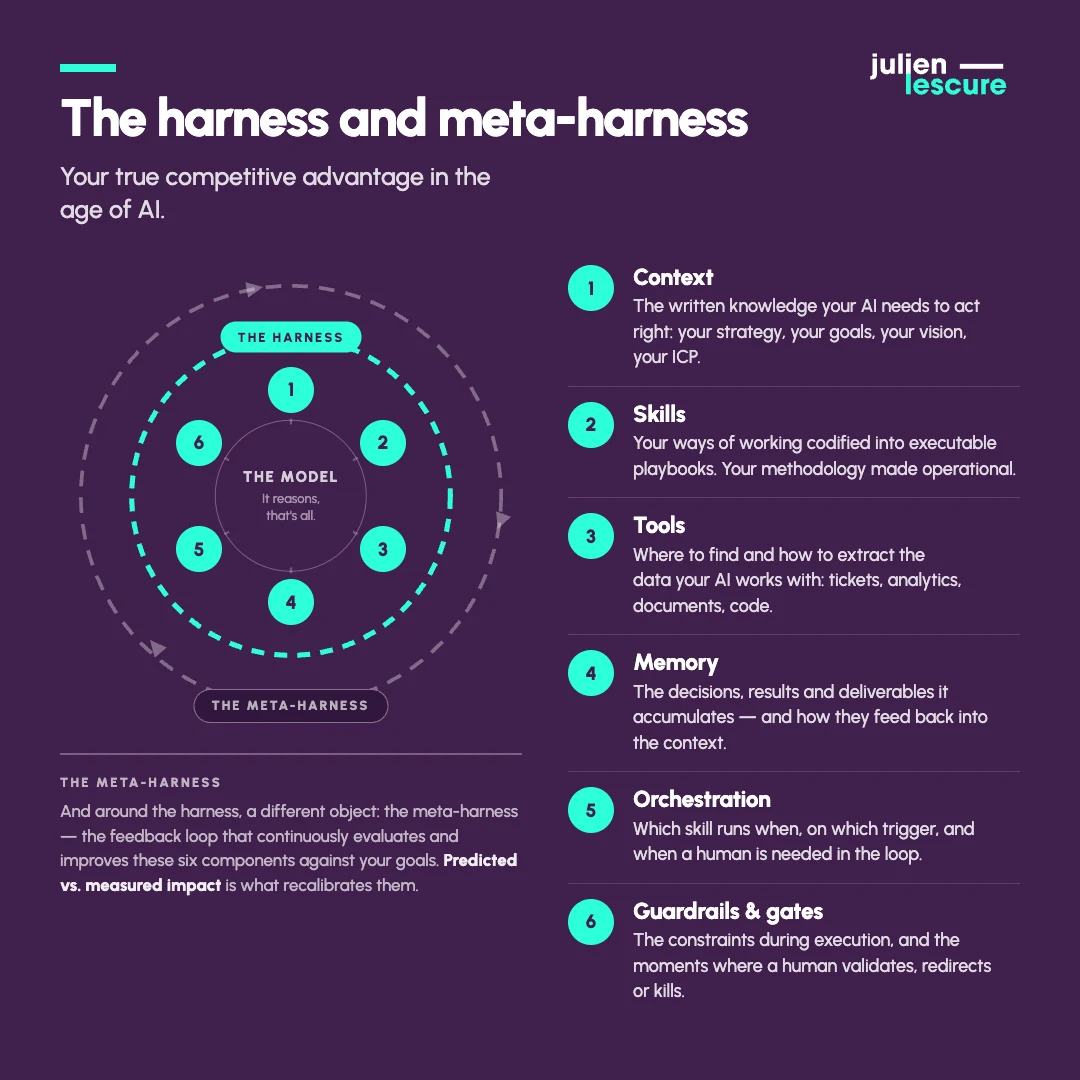
What will make you win: everything you build around the model and how you orchestrate its use — the famous "AI harness": your context, your skills, your tools, your guardrails, your decision and validation gates. That's where your competitive advantage is built.
When Claude Code's source code leaked in March, an analysis showed that about 98.4% of it was harness infrastructure — permissions, context management, tool routing — and only 1.6% AI decision logic.
Even the AI labs build their competitive advantage on the harness.
So what exactly is a harness? It's what makes your AI know your company, know where to find what it needs to work, collaborate with your teams the best possible way, and evaluate its results against your goals.
Its components:
1/ Context: the written knowledge it needs to act right: your strategy, your goals, your vision, your mission, your ICP.
2/ Skills: your ways of working codified into executable playbooks. Your methodology, made operational.
3/ Tools: where to find and how to extract the source data to work with: tickets, analytics, documents, code.
4/ Memory: the thinking, the decisions, the results, the deliverables — and how they feed back into the context.
5/ Orchestration: which skill runs when, on which trigger (automatic or manual), and when a human is needed in the loop.
6/ Guardrails and decision thresholds: the constraints during execution, and the moments where a human must approve, redirect or abandon the task.
And around the harness sits something different: the "meta-harness" — the feedback loop that permanently evaluates and improves these 6 components against your goals. The harness runs your work; the meta-harness makes the harness better.
Without a harness: deliverables you can't compare, disparate ways of working, results that vary by person, and productivity gains that crumble at every handoff between teams.
A quick check? Can you easily compare your teams' work to prioritize or decide fast? Does your AI work from your context and your goals, or just from the questions you ask it? Are your goals the performance benchmark for your AI?
This is the work I do with my clients and their teams: building the AI harness that becomes their true competitive advantage — encoding their context, their skills, their guardrails, and working with the teams to go get that 10x in productivity.
If this resonates, let's talk!